
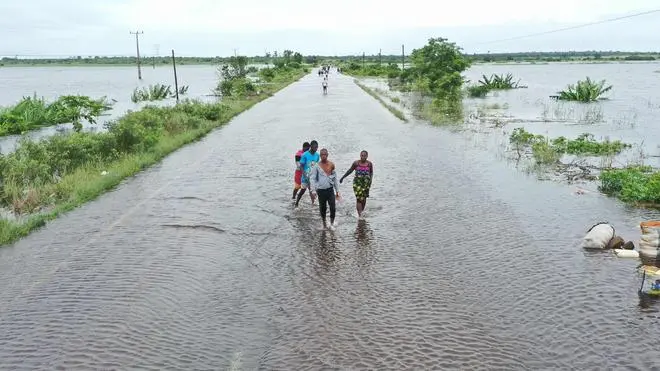
In early January 2026, catastrophic floods swept across parts of southern Africa, with Mozambique bearing the brunt of the disaster. Over half a million people have been affected, homes destroyed, and communities facing heightened risks of disease and malnutrition. Gaza, Maputo, and Sofala provinces have been particularly hard-hit, with 29,618 houses partially or completely destroyed. In Gaza province alone, around 330,000 people are affected.
Entire communities are submerged, and dangerous wildlife, such as crocodiles, have been forced into urban areas. Children are especially vulnerable, with UNICEF warning that unsafe water and malnutrition could turn this disaster into a deadly threat for the youngest survivors. One displaced mother in Gaza province recounted losing everything in a single night, including crops and livestock.
“These are not just statistics; they’re lives upended by events that are becoming more frequent and severe,” said Dr. Bridget Scanlon, senior research scientist at the University of Texas at Austin.
Climate Change Fuels Extreme Flooding
Experts highlight that human-induced climate change is amplifying extreme weather events. Warmer atmospheres hold more moisture, leading to heavier rainfall during storms. Global temperatures have already risen over 1.2°C since pre-industrial times, making floods more likely and more destructive.
“In southern Africa, this translates to floods that are not only more likely but also more destructive,” Dr. Scanlon explained. Natural climate patterns like El Niño are interacting with warming trends, intensifying rainfall and worsening flooding. Mountains are warming faster than expected, shifting snowfall to rain and heightening flood risks downstream.
A Global Pattern of Catastrophe
Flooding is not limited to Africa. January 2026 has seen floods in Europe, New Zealand, and the United States. Storm Harry caused severe flooding in Malta, Corsica, Catalonia, and Sicily, while New Zealand’s North Island faced evacuations and landslides. In the US, record rainfall led to river flooding and road closures in Wisconsin.
“Climate change is making floods hit more places and people, with sea level rise worsening coastal impacts and erratic weather patterns amplifying inland risks,” Dr. Scanlon said.
The 2026 Climate Risk Index highlights that floods account for nearly half of all people affected by disasters over the past 30 years, often due to extreme events intensified by warming.
Preparing for a Warming World
Traditional flood predictions based on historical data are becoming unreliable. Droughts and floods will become more frequent and severe, making preparation and infrastructure investment critical. Experts stress the importance of resilient bridges, early warning systems, and community support to prevent secondary disasters such as disease and malnutrition.
“Communities need support now for clean water and nutrition, and globally, reducing emissions is the ultimate solution—every fraction of a degree matters,” Dr. Scanlon emphasized.
A Wake-Up Call for Humanity
The 2026 floods serve as a stark reminder that these disasters are not random. They are the predictable outcomes of a warming planet. While science provides the tools to adapt, the stories of survivors show that this is about people, not just data. Immediate action is needed to prevent the next deluge and protect vulnerable communities worldwide.
“These floods are a wake-up call. Let’s act before the next deluge,” Dr. Scanlon concluded.